


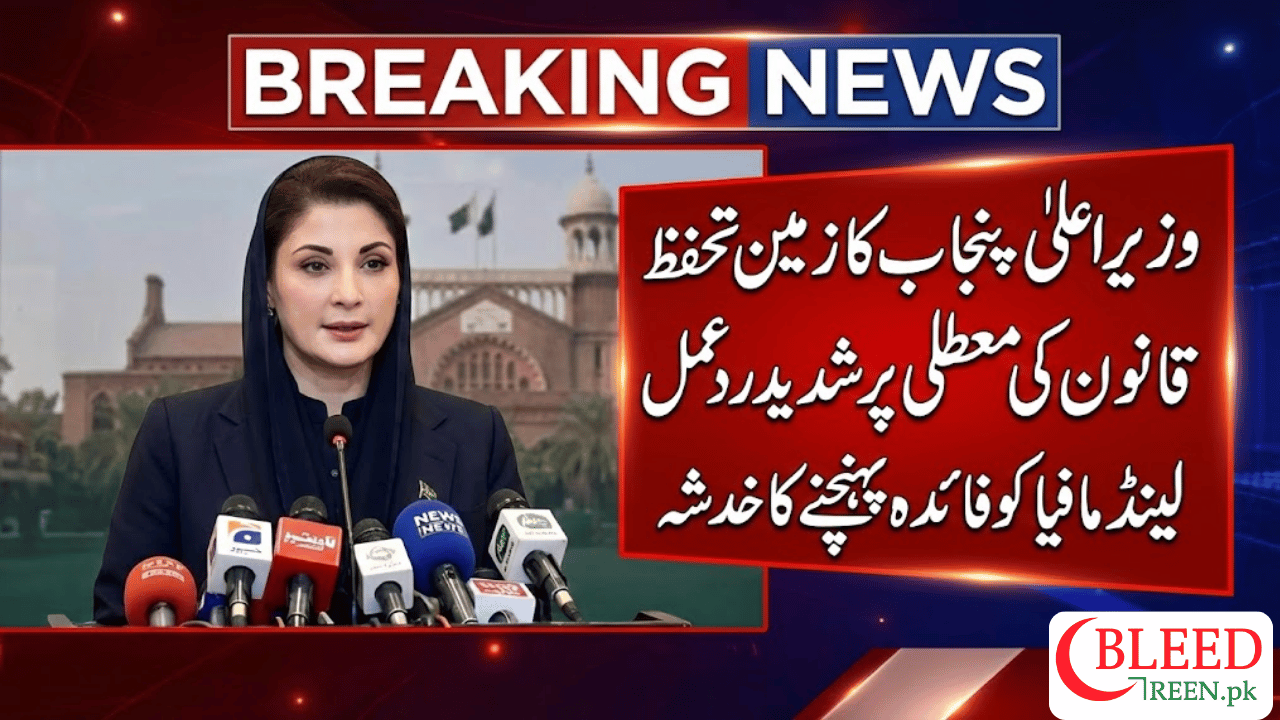
Punjab Chief Minister Maryam Nawaz Sharif has raised serious concerns over the Lahore High Court’s decision to suspend the Punjab Protection of Ownership of Immovable Property Act, 2025, stating that the move could strengthen land-grabbing and encroachment mafias across the province.
The chief minister’s remarks come after the Lahore High Court issued an interim order halting the implementation of the newly introduced law, which aimed to resolve land and property disputes within a fixed time frame.
What Is the Punjab Protection of Ownership of Immovable Property Act, 2025?
The Punjab Protection of Ownership of Immovable Property Act, 2025 was introduced to address one of Punjab’s most persistent problems: prolonged land and property disputes.
Key objectives of the law included:
-
Resolving land and property cases within 90 days
-
Providing fast relief to rightful property owners
-
Reducing decades-long litigation in civil courts
-
Protecting citizens from powerful land grabbers
Under the law, dispute resolution committees led by deputy commissioners were authorised to handle cases efficiently while following legal procedures.
Maryam Nawaz: “Law Was Meant to Protect Ordinary Citizens”
In an official statement, Maryam Nawaz said the law was enacted to offer long-awaited relief to millions of citizens whose property cases have remained unresolved for years — and in some cases, generations.
According to the chief minister:
-
The law was designed to protect poor and vulnerable citizens
-
Widows, low-income families, and helpless individuals were among the biggest beneficiaries
-
The legislation aimed to curb the influence of land mafias who exploit legal delays

She stressed that the Punjab Assembly, as a democratically elected body, passed the law to restore public trust in the justice system.
Concerns Over Suspension of the Law
Maryam Nawaz warned that suspending the law could reverse progress made against illegal land occupation. She argued that the decision would:
-
Benefit encroachment and land-grabbing mafias
-
Delay justice for rightful property owners
-
Reinforce a system where influential groups manipulate legal loopholes
She added that prolonged stay orders have historically blocked justice, allowing illegal occupants to remain on disputed land for decades.
“This Is Not About Personal Benefit,” Says CM
Addressing criticism, the chief minister clarified that the law was not enacted for her personal gain.
“This legislation does not benefit me personally, nor does its suspension harm me personally,” she stated.
She emphasised that the real impact would be felt by:
-
Poor families
-
Widows
-
Marginalised communities
-
Citizens who had finally begun to see hope of justice
According to her, halting the law risks shattering that renewed confidence.

LHC’s Observations on the New Property Law
During the hearing, Aalia Neelum, Chief Justice of the Lahore High Court, expressed strong reservations about the law.
The court observed that:
-
The legislation appeared to concentrate excessive authority
-
It could undermine civil courts and judicial supremacy
-
Revenue officers should not have powers overlapping with civil courts
The chief justice questioned how possession of property could be transferred administratively while a related case is pending before a civil court.
Legal Debate: Authority of the Provincial Assembly
Maryam Nawaz maintained that legislation is a constitutional right of the provincial assembly and should not be obstructed without strong legal grounds.
She argued that the law was:
-
Evidence-based and comprehensive
-
Designed to balance administrative efficiency with legal safeguards
-
Introduced to address systemic injustice in land disputes
The chief minister reiterated that blocking such reforms only strengthens those who profit from legal delays.
Why This Issue Matters to the Public
Land and property disputes are among the most common legal conflicts in Punjab. Many cases remain unresolved for decades, causing financial loss, emotional stress, and social instability.

If implemented, the suspended law could have:
-
Reduced case backlogs
-
Improved investor confidence
-
Strengthened property rights
-
Weakened the influence of land mafias
Its suspension has therefore sparked widespread debate among legal experts, policymakers, and the public.
Key Takeaways
-
Punjab CM has strongly opposed the suspension of the land protection law
-
The law aimed to resolve property disputes within 90 days
-
LHC suspended the act over concerns about judicial authority
-
Government fears the move will benefit land-grabbing mafias
-
The issue has major implications for property rights and justice delivery
Final Thoughts
The suspension of the Punjab Protection of Ownership of Immovable Property Act, 2025 has reignited an important debate about judicial authority, administrative reform, and access to justice. While the court has raised constitutional concerns, the Punjab government insists the law was a necessary step to protect citizens from exploitation.
As legal proceedings continue, millions of property owners across Punjab await clarity on whether this reform will be revived or permanently altered — a decision that could shape the future of land rights in the province.

