


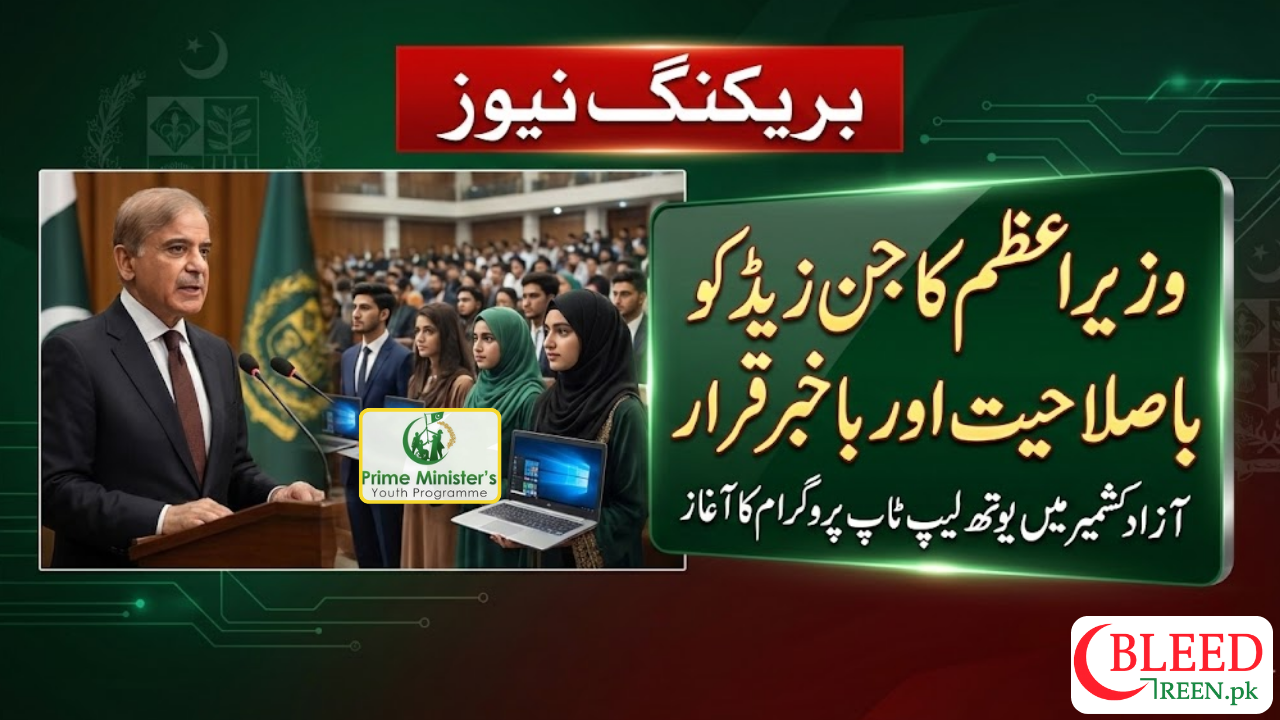
Prime Minister Shehbaz Sharif has described Pakistan’s youth—particularly Generation Z—as the country’s greatest strength, saying investment in education and digital skills is an investment in the nation’s future.
He made these remarks while launching the Prime Minister’s Youth Laptop Programme in Azad Jammu and Kashmir at the University of Azad Jammu and Kashmir (UAJK).
“Laptops Are Gateways to Knowledge and Opportunity”
Addressing students and faculty, the prime minister said laptops are not merely devices but tools that connect young people to global knowledge, skills, and opportunities. He cited success stories from earlier phases of the programme, where students used laptops to build careers and overcome social and economic barriers.
“Our youth—especially Gen Z—are more aware, more capable, and better equipped to use technology than earlier generations,” he said, urging students to harness digital tools responsibly.
Call for Responsible Digital Citizenship
The prime minister cautioned against the spread of misinformation and fake news, stressing that educated youth must stand for facts, ethics, and responsibility in the digital and social media space.
He also reiterated that the laptop programme has been implemented strictly on merit, rejecting claims of political favouritism. The continuity of education during the Covid-19 pandemic, he noted, underscored the programme’s value.
New Education Initiatives for AJK and Beyond
Announcing a broader education roadmap, the prime minister revealed several initiatives:
-
Four Danish Schools approved for AJK

-
A planned tech-focused Danish University
-
Revival of the Prime Minister’s Education Endowment Fund to support talented but underprivileged students from AJK, Gilgit-Baltistan, Balochistan, and other regions—including overseas scholarships
Kashmir and National Unity
Touching on Kashmir, he said the people of the region have made immense sacrifices and share an unbreakable bond with Pakistan. He reaffirmed Pakistan’s political, moral, and diplomatic support for Kashmiris, calling for unity, hard work, and faith to achieve national goals.
Ports Reforms: Boosting Trade and Connectivity
Later, chairing a meeting on ports reforms, the prime minister emphasized the role of ports in economic growth and business activity. He directed:
-
Better inter-departmental coordination to reduce cargo dwell time
-
Further reduction of port charges
-
Transparent e-auction of abandoned cargo

-
Establishment of initial testing labs at ports and removal of unnecessary testing
-
Faster dredging and expansion to berth larger vessels
-
Improved rail connectivity for inland cargo movement
Officials briefed that the National Ports Master Plan is progressing, a Port Community System is operational, and bulk cargo fees at Port Qasim have seen over 50% reductions.
PIA Privatisation: A “Major Milestone”
The prime minister also praised the team behind the privatisation of Pakistan International Airlines (PIA), calling its completion a major milestone in the national interest.
Key highlights:
-
Live, transparent bidding concluded at Rs135 billion for a 75% stake

-
Total valuation reached Rs180 billion including the government’s 25% share
-
Aim to offload loss-making SOEs swiftly and transparently
He expressed confidence that new management would bring fresh investment, modern equipment, and aircraft, improving PIA’s performance. Team members were lauded, with the Privatisation Commission chairman announced for national recognition.
The Takeaway
From empowering Gen Z through technology and education to accelerating ports reforms and completing PIA’s privatisation, the government signaled a push for skills-led growth, transparency, and economic revival.
Follow BleedGreen.pk for verified updates on education, economy, and national policy.

