


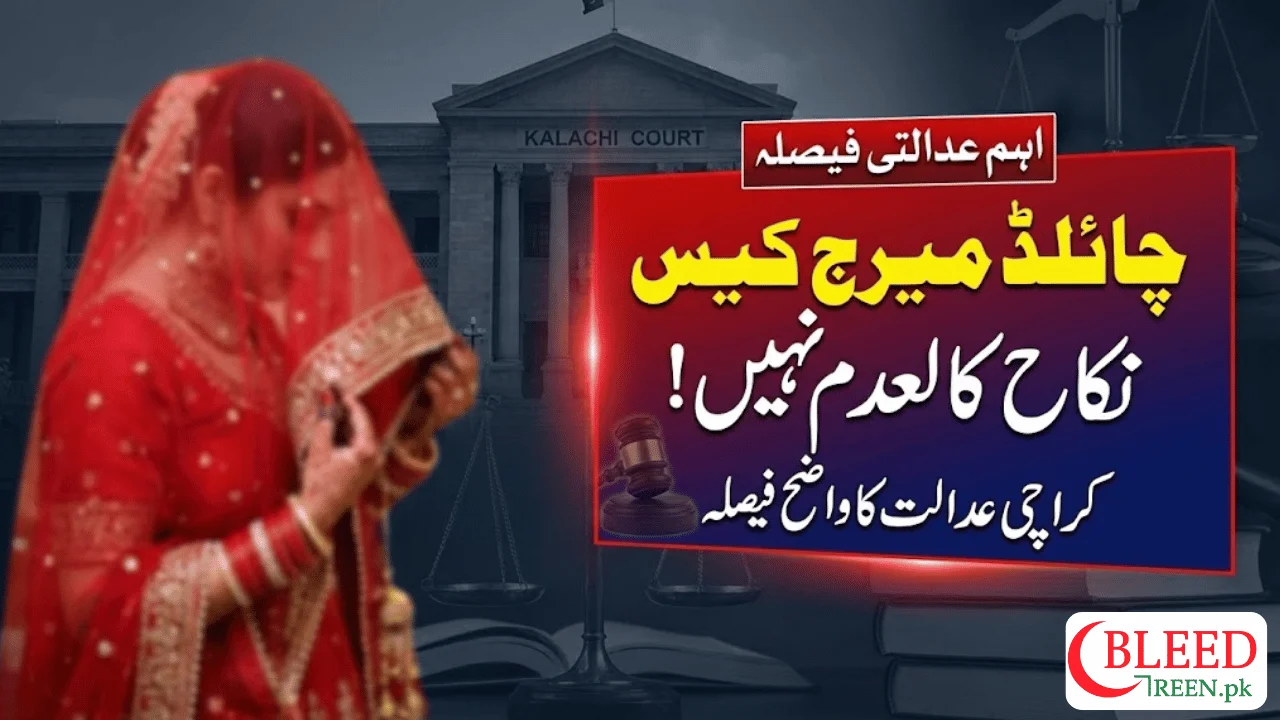
A Karachi sessions court has ruled that a conviction under the Sindh Child Marriage Restraint Act, 2013 does not automatically invalidate a marriage or render the nikkah void, clarifying an important legal distinction between criminal liability and personal law.
The observation was made by Additional District and Sessions Judge Zahoor Ahmed Chandio while sentencing a man for marrying an underage girl. The judge noted that the child marriage law is penal in nature and does not contain any provisions for annulling a marriage.
Court Clarifies Legal Scope
In its detailed judgment, the court stated that:
A conviction under the Sindh Child Marriage Restraint Act does not affect the validity of the nikkah from a personal law perspective. The law serves as a restraint and punishment mechanism rather than a basis for annulment.
The court further explained that the validity of a marriage contract falls under the jurisdiction of family courts or relevant personal law forums, not criminal courts handling penal offences.
Two-Year Sentence Awarded
The accused, Zulqarnain alias Cheeko, was found guilty under Section 3 of the Sindh Child Marriage Restraint Act, 2013 and sentenced to two years of imprisonment. The court also imposed a fine of Rs25,000, with additional imprisonment in case of default.

However, the court made it clear that the punishment was limited strictly to the offence of contracting a child marriage.
Serious Charges Not Proven
The accused had also faced charges under:
-
Section 365-B (abduction for marriage)
-
Section 376(3) (rape of a minor)
After reviewing evidence and witness testimony, the court acquitted the accused of these charges, ruling that the prosecution failed to prove allegations of abduction and sexual assault.

Victim’s Testimony Played Key Role
During cross-examination, the girl stated that she was not abducted and that the nikkah was performed with her consent, without coercion. Her mother also acknowledged that the girl had not alleged kidnapping when they met at the police station.
The court noted that the girl had:
-
Submitted a free-will affidavit
-
Refrained from alleging force during investigations
-
Recorded her statement through her own legal counsel

Medical evidence also did not support claims of rape, according to the judgment.
Medical Evidence Confirmed Minor Age
Despite the victim’s claim that she was 18 or older at the time of marriage, medical evidence established her age between 14 and 15 years, confirming that she was legally a minor when the nikkah took place.
The court observed that scientific medical findings outweighed verbal claims, establishing the offence under the child marriage law.
Legal Significance of the Ruling
Legal experts say the ruling reinforces the distinction between criminal accountability and family law matters, while also underlining that child marriage remains a punishable offence regardless of consent.
The judgment is expected to serve as an important reference for future cases involving child marriage prosecutions in Sindh.

