


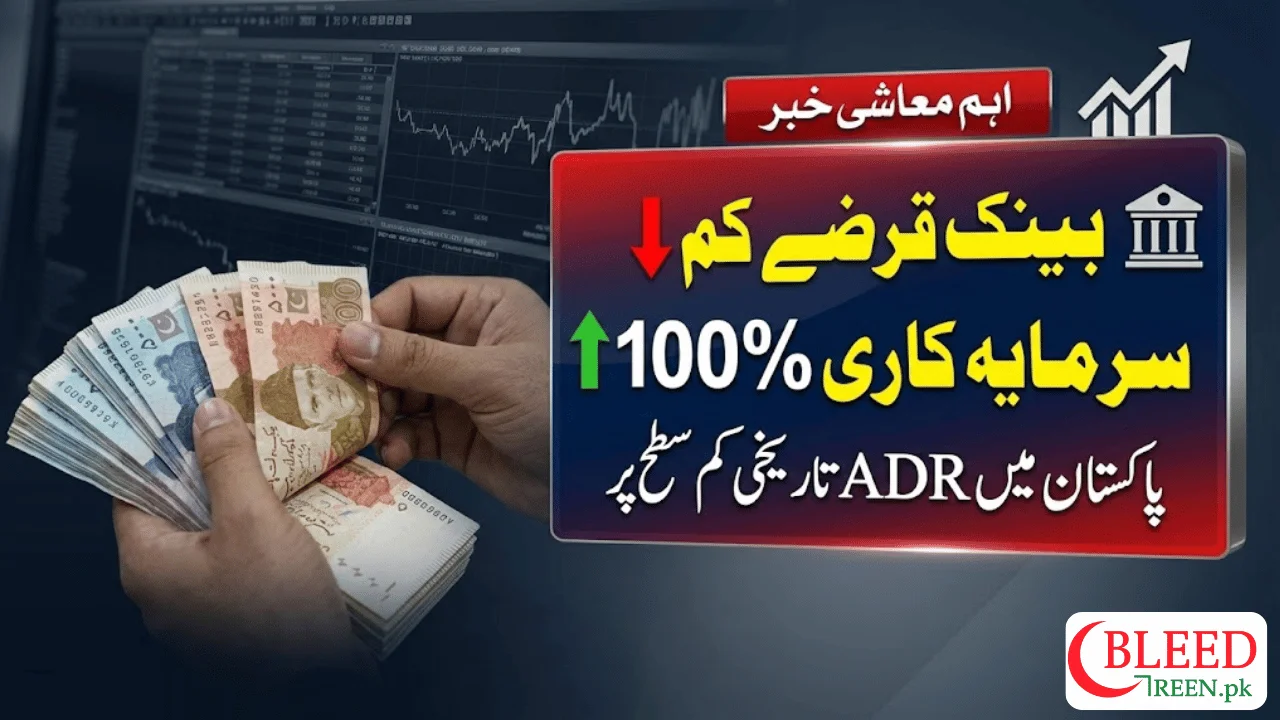
Pakistan’s banking sector is undergoing a significant structural shift as lending to the private sector continues to weaken while investments dominate bank balance sheets. According to a new industry report released in late 2025 and shaping trends into 2026, the advances-to-deposits ratio (ADR) has fallen sharply to 35%, while the investments-to-deposits ratio (IDR) has climbed to 100%.
This development highlights deep-rooted challenges in credit growth, financial inclusion, and economic expansion—despite improvements in digital payments and priority-sector financing.
Key Banking Indicators at a Glance (2026)
-
ADR (Advances-to-Deposits Ratio): 35%
-
IDR (Investments-to-Deposits Ratio): 100%
-
Private sector credit: 11% of GDP
-
Undocumented economy: ~40% of GDP
These figures come from the latest banking outlook report published by PwC – A.F. Ferguson, which reviews the sector’s performance and future direction.
What Does a 35% ADR Mean?
The ADR shows how much of bank deposits are being used for lending to businesses and individuals. A ratio of 35% means that banks are lending only about one-third of their deposits to the private sector.
Regional comparison
Pakistan’s ADR is significantly lower than:
-
Bangladesh: ~87%
-
India: ~79%
-
Sri Lanka: ~59%
This gap indicates that Pakistani banks are far less involved in financing economic activity compared to regional peers.
Why Is IDR at 100% a Concern?
The IDR measures how much banks invest—mainly in government securities—relative to deposits. An IDR of 100% means banks are placing nearly all their deposits into investments rather than private-sector lending.
What this signals:
-
Strong preference for risk-free government instruments
-
Weak appetite for business and SME lending
-
Limited flow of credit to productive sectors
While safe for banks, this trend slows job creation, investment, and long-term growth.
Lending to SMEs and Agriculture Still Lagging
Despite recent improvements, financing to priority sectors remains below regional standards.
Current contribution to total loans:
-
SMEs: ~5%
-
Agriculture: ~5.2%
By comparison:
-
Indonesia: ~19% SME lending
-
Bangladesh: ~17%
-
India: ~16%
This is concerning because:
-
SMEs contribute about 40% of GDP
-
Agriculture contributes roughly 24% of GDP
-
Together, these sectors employ millions of workers across Pakistan
Some Positive Signs in 2025–26
There are early indicators of recovery in priority-sector financing:
-
Agricultural borrowers increased to 2.9 million
-
SME borrowers rose by over 55%, reaching 277,000
-
Financing to priority sectors crossed 10% of total loans, reversing earlier declines
However, experts caution that these gains are still insufficient compared to the size of the economy.
The Undocumented Economy: A Major Barrier
A major reason behind weak lending is Pakistan’s cash-heavy and undocumented economy, estimated at around 40% of GDP.
Why this matters:
-
Cash-based transactions limit credit assessment
-
Informal businesses remain outside the banking system
-
Tax collection and financial transparency suffer
Experts estimate that:
-
Digitising transactions could save Rs164 billion annually
-
Reducing the undocumented economy by 25% could unlock over Rs1 trillion in resources
Digital Payments Are Growing, But Unevenly
Pakistan has made notable progress in digital finance, especially through State Bank of Pakistan initiatives.
Key digital milestones:
-
Raast instant payment system:
-
45 million registered IDs
-
1.3 billion transactions
-
Rs29.6 trillion in value (by June 2025)
-
-
QR-enabled merchants crossed 1 million
But challenges remain:
-
Cash-in-circulation ratio: 34% (much higher than regional peers)
-
POS terminals: only ~159,000 merchants
-
Mobile banking penetration: ~15% of bank accounts
This shows that digital adoption is improving, but not yet widespread across the economy.
What Experts Say Needs to Change in 2026
To rebalance the banking system and support sustainable growth, experts highlight several priorities:
-
Stronger fiscal discipline
-
Comprehensive tax reforms
-
Better governance of state-owned enterprises
-
Reduced reliance on government borrowing
-
Expansion of export-oriented and value-added industries
-
Simplified regulations to attract domestic investment
A shift from consumption-led growth to investment- and export-driven growth is seen as critical.
Final Takeaway
As Pakistan moves through 2026, the banking sector’s numbers tell a clear story:
Banks are safer, but the economy is credit-starved.
The sharp fall in ADR to 35% and the rise in IDR to 100% underline the urgent need to:
-
Expand private-sector lending
-
Bring informal businesses into the documented economy
-
Accelerate digital payments and financial inclusion
Without these changes, economic growth will remain constrained—despite improving technology and regulatory frameworks.

