


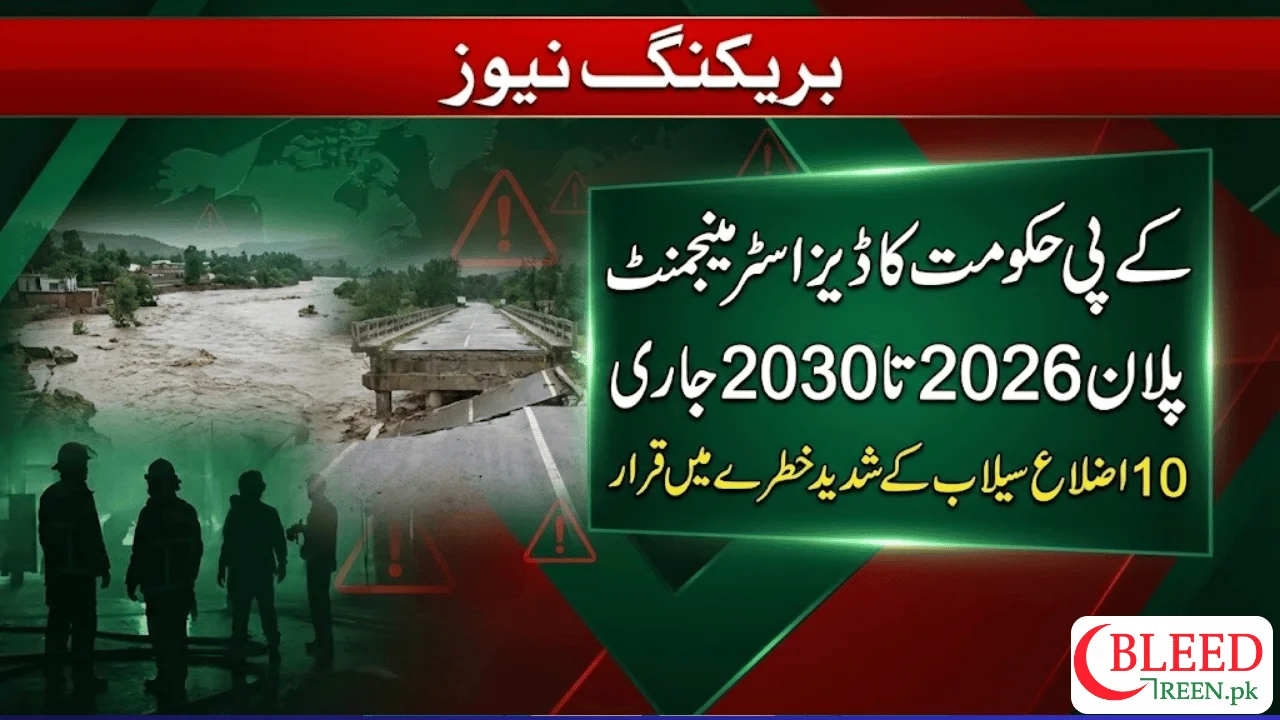
The Khyber Pakhtunkhwa government has unveiled a comprehensive Provincial Disaster Management Plan (PDMP) 2026–30, identifying 10 districts as highly vulnerable to floods, two to landslides, and one each to heavy snowfall and glacial lake outburst floods (GLOFs). The plan aims to reduce disaster-related losses, strengthen preparedness, and build climate resilience across the province.
Why the Plan Matters
Officials say the PDMP 2026–30 responds to escalating climate risks—including floods, earthquakes, droughts, heatwaves, and erratic rainfall—that increasingly threaten lives, livelihoods, and infrastructure. The strategy focuses on risk reduction, early warning, and rapid response, alongside long-term resilience.
Most At-Risk Districts Identified
According to the plan’s hazard profiling:
-
Floods (High Vulnerability – 10 districts): Chitral (Lower & Upper), Buner, Swat, Shangla, Nowshera, Charsadda, Dera Ismail Khan, Peshawar, Swabi, Mardan
-
Landslides: Mansehra (high), with mountainous belts under watch
-
Snowfall & GLOFs: Upper Chitral and adjoining high-altitude zones
Lower and Upper Chitral stand out as the most multi-hazard exposed, facing snowfall, floods, landslides, GLOFs, and composite risks.
Rivers, Terrain, and Monsoon Risks
The plan highlights how the province’s river network—Indus, Kabul, Swat, Chitral, Kunar, Siran, Panjkora, Bara, Kurram, Dor, Haro, Gomal, and Zhob—combined with rugged terrain, deforestation, and intense monsoons, amplifies flood risk. Rapid runoff during peak rains often overwhelms nearby communities and infrastructure.

Climate Change: Droughts and Heatwaves Rising
Climate projections in the PDMP warn of:
-
Reduced rainfall and prolonged droughts, threatening agriculture and food security—especially in Karak, Lakki Marwat, Bannu, and Dera Ismail Khan
-
Rising temperatures and more frequent heatwaves, accelerating glacier melt and triggering GLOFs, flash floods, and debris flows
Recent summers have already disrupted daily life and caused disasters in both urban centers and mountainous regions.
Key Gaps the Plan Targets
The government lists multiple contributing factors to vulnerability:
-
Rapid population growth and unplanned urbanisation
-
Encroachments and human displacement

-
Weak early warning systems and limited awareness
-
Insufficient health and emergency facilities
What the PDMP 2026–30 Will Do
The plan outlines 12 policy interventions backed by 83 strategic actions, including:
-
Operationalising and modernising the provincial disaster management system
-
Digitising risk assessments and data platforms
-
Developing disaster plans at provincial, district, and local levels
-
Strengthening multi-hazard early warning systems

-
Promoting climate-smart, disaster-resilient development
-
Establishing a Provincial Disaster Response Force
-
Expanding training, research, and community engagement
-
Introducing risk financing, compensation frameworks, and recovery capacity
Implementation will be overseen by a Plan Implementation Committee, with regular reviews, a funding roadmap aligned to the provincial budget, and a monitoring & evaluation framework to track progress and accountability.
The Bottom Line
With climate shocks intensifying, KP’s Disaster Management Plan 2026–30 sets a clear roadmap to protect lives and livelihoods, improve preparedness, and reduce losses. Success will hinge on timely funding, inter-agency coordination, and community participation.
Follow BleedGreen.pk for updates on climate policy, disaster preparedness, and public safety across Pakistan.

